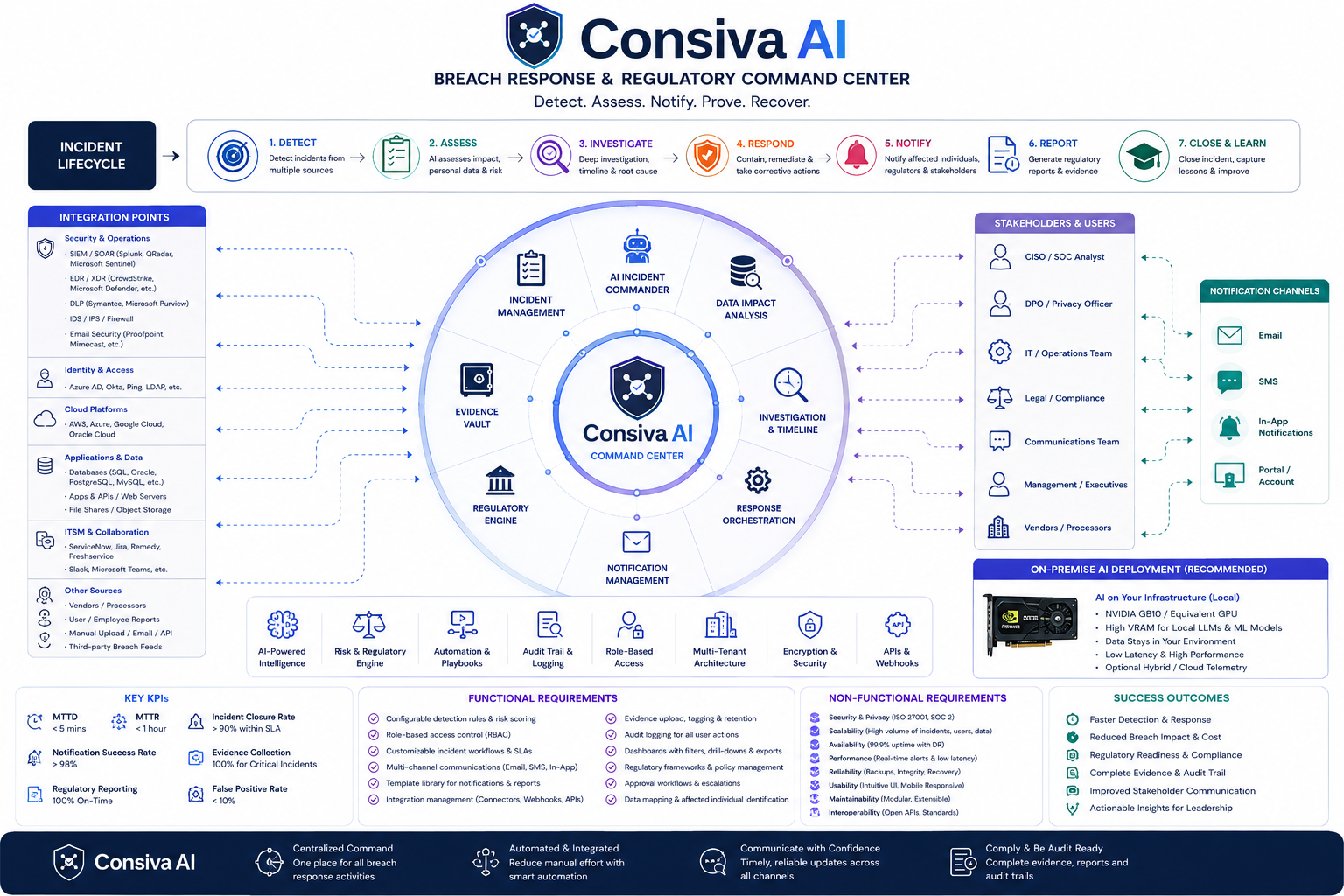
That's why enterprises need more than just a SIEM alert or an incident-ticket to get them out of trouble. They really need a Breach Response & Regulatory Command Center that can bring all relevant security systems together, help figure out what personal data got compromised, determine which regulations they have to worry about, get all the response teams on the same page, let affected people know what's going on, preserve evidence so it don't get lost, and give management a clear picture of what happened to the business.
For Indian companies, this has become a much bigger deal in recent years because of all the changes to the country's data-protection and cybersecurity laws: the Digital Personal Data Protection Act, 2023 (DPDP Act) & its 2025 rules, the Information Technology Act of 2000, and then there's CERT-In's framework for reporting cyber-incidents — it's all coming together and making this kind of set-up a really pressing need.
Consiva AI is designed around this exact problem: helping enterprises move from breach detection to regulatory closure through one integrated command center.
What Is a Breach Response & Regulatory Command Center?
A Breach Response and Regulatory Command Center is a special kind of enterprise platform that brings all the right people, systems, data, workflows, comms, evidence and regulatory hoops to jump through all under one roof. It's all about making sense of a security or personal data incident and figuring out how to deal with it.
Rather than having teams frantically trying to piece together info from disconnected tools, spreadsheets, email threads, SIEM consoles, ticketing systems, cloud logs and heaps of legal documents, the command center gives you one place to work from — and one place to work from start to finish, from:
Detect → Assess → Investigate → Respond → Notify → Report → Remediate → Close
It's a real lifesaver when an incident involves both cyber threats and personal info, that's for sure.
Why Businesses Need a Breach Command Center
Old school security tools are great for spotting odd behavior, sure. But spotting is kinda just step one, you know, not the whole movie.
When an actual breach shows up, executives and leaders don't really get the luxury of guessing around. They start asking, right away, stuff like:
- What happened in the real timeline, and when did someone first detect it?
- Which apps and systems are truly implicated, not just “maybe” implicated?
- Was personal data involved, and if yes what kinds of data, and roughly how many people might be affected?
- Was the data accessed, copied, modified, or even wiped out?
- Which regulators, customers, employees, suppliers, or partners have to be informed and by what deadline — the real one, not some vague estimate that floats around?
- Who is accountable for each action taken during response, and what evidence shows the organisation handled it properly?
- And what corrective activities are still open, waiting to be closed the right way?
A command center kind of turns all that messy questioning into a structured, auditable workflow, so the teams can move together, not in separate lanes, and document everything for later review.
India's Evolving Breach-Response Landscape
The Information Technology Act 2000 sets up CERT-In under Section 70B as the national agency for cyber incident response. CERT-In handles things like collecting and evaluating cyber incident details, coordinating the response work, and publishing guidance for incident prevention, response, and reporting.
CERT-In's current directions require specified cyber incidents — including data breaches and data leaks — to be reported within six hours of noticing the incident or being informed about it. CERT-In also states that information available at the time of reporting may be submitted initially, with additional information provided later.
The DPDP framework adds a separate personal-data protection dimension. The final DPDP Rules, 2025 provide that when a Data Fiduciary becomes aware of a personal-data breach, affected Data Principals are to be informed without delay, with information about the nature, extent and timing of the breach, likely consequences, mitigation measures, recommended safety actions, and a contact person. The Rules also provide for notification to the Data Protection Board without delay and detailed information within 72 hours, unless the Board allows a longer period.
CERT-In Clock ⏳
Report to CERT-In from the moment your organisation becomes aware of a qualifying cyber incident. Runs 24/7.
DPDP Board Clock ⏳
Detailed information to the Data Protection Board, unless the Board allows a longer period. Data Principals are informed without delay.
Important implementation point: the Government's commencement notification puts the substantive DPDP provisions covering Sections 3–17 into the 18-month commencement tranche from 13 November 2025. The final DPDP Rules similarly place Rule 7 among the provisions that commence 18 months after publication. Businesses should architect for the future DPDP breach workflow while continuing to meet currently applicable cybersecurity obligations.
CERT-In and DPDP: Why One Incident Can Create Multiple Workflows
A critical concept for enterprise incident response is that a cyber incident and a personal-data breach are not necessarily the same thing. There are three broad scenarios:
Cyber incident, no personal data in play
A ransomware attack hits an internal system, but the investigation turns up nothing to worry about, no personal data was exposed. This kicks off the standard cyber response and CERT-In reporting — and that's where it stays, no need to go down the personal data breach track.
A straightforward personal-data breach
An employee sends a customer database to the wrong person. We're not talking about some kind of high-tech cyber heist, but personal data might have been let out of the bag.
Cyberattack plus personal data leak
An attacker gets into a database and makes off with customer records — now you're looking at a whole lot of trouble. The organisation potentially faces both cybersecurity response and personal-data breach response at once.
The same event can trigger one workflow, or two — a modern command center should tell them apart automatically.
The Consiva AI Breach Response Lifecycle
Consiva's approach is built around a simple enterprise lifecycle:
1. Detect
Bring incident signals into one platform from multiple sources: SIEM and SOAR, EDR/XDR, DLP, IAM and identity systems, firewalls and network security, cloud platforms, databases, applications and APIs, email security, vulnerability-management platforms, employee reports, vendors and processors, and APIs and webhooks. The goal is to move from isolated alerts to a single incident context.
2. Assess
Once an incident is created, AI evaluates the event. Consiva can help determine incident category, severity, affected systems, potential personal-data involvement, affected datasets and data categories, possible regulatory implications, probable business impact, and evidence gaps — producing a structured incident assessment rather than an unprioritised alert.
3. Investigate
The investigation layer correlates alerts, logs, identity activity, database access, application events, cloud activity, evidence files, user reports, and communication records. Consiva can put together a timeline of what happened, when it happened, and all the details in between — and it does this with a bit of AI help — instead of leaving it up to analysts to piece it all together from scratch.
4. Respond to the Situation
The command center takes the facts from the analysis and turns them into action items — shut down a compromised account, get new logins rolling, lock down the system, cut off access, block a bad IP/domain, patch up that vulnerability, make sure the vendor doesn't have too much access, make sure we keep the evidence safe, get legal or the privacy people involved, and start telling everyone what's going on. Each one of these tasks can have an owner on it, a priority, a deadline, its status, and the evidence to back it up.
5. Notify
One of the most important capabilities is stakeholder communication. Consiva can generate and manage notifications for affected customers, employees, Data Principals, regulators, legal teams, management, vendors, partners, and internal incident teams, across email, SMS, in-app, portal, and other configured enterprise communication channels.
The DPDP Rules describe notification to affected Data Principals through their user account or a registered communication mode, and require clear, concise communication about the breach and its consequences. A command center can therefore combine communication generation with approval and delivery tracking.
Don't Manage Breach Timers Manually
Consiva automatically starts both the CERT-In 6-hour timer and the DPDP notification timer the moment an incident is logged — with auto-drafted reports for both.
Start Free on Consiva.ai — No Credit Card →From Notification to Proof: The Evidence Vault
Sending a message is not enough. An enterprise may later need to demonstrate what notification was sent, to whom, when it was sent, which version was approved, who approved it, whether delivery succeeded, what remediation occurred, and which evidence supported the decision. This is why the Evidence Vault becomes a core component of the platform.
The Consiva Evidence Vault should centralise incident evidence such as SIEM logs, EDR alerts, cloud and database logs, forensic reports, screenshots, investigation notes, approval records, regulatory reports, notification copies, delivery receipts, remediation evidence, and communication history — each associated with the incident, finding, action, person/system, and timestamp involved, so the result is an auditable incident record rather than a collection of disconnected documents.
The DPDP Rules also place emphasis on security safeguards, including encryption, access control, monitoring and review of access, backups, logging, and measures supporting investigation and remediation.
AI-Powered Breach Response
The biggest opportunity is not simply using AI to write a report. AI can become the incident command layer. A Consiva AI Incident Commander could be super helpful to teams by making sense of the current state of the incident from all different sources, giving them a good summary, figuring out what kind of incident it is, showing how it all connects — to what applications, datasets, categories of data and people — figuring out the risks to the operation and the regulators, suggesting what to do to stop it, get to the bottom of it, and fix it, drafting emails to send to stakeholders and regulators, keeping track of deadlines, approvals and what still needs to be done, and finally learning from what just happened to make recommendations for next time.
AI Agents for the Breach Command Center
A modular AI architecture can support specialist agents such as:
Together, these agents create an AI-assisted operating layer around the incident workflow.
Why Local AI Matters for Enterprise Breach Response
One of the most important architectural decisions for enterprises is where the AI processing happens. Security and privacy teams may not want incident logs, customer data, forensic information or sensitive evidence transmitted to external AI services. A local or private deployment model allows the enterprise to run AI workloads inside its own controlled environment.
Example architecture: Enterprise Systems → Consiva → Local AI Compute → Local LLMs → Incident Intelligence
This can be deployed on on-premise infrastructure, private cloud, hybrid infrastructure, isolated environments, and air-gapped environments where appropriate. For high-performance local AI workloads, platforms built around NVIDIA GB10-class or equivalent AI compute can provide the processing layer for local LLMs, investigation assistants, summarisation, classification and other AI workloads. The objective is straightforward: keep sensitive incident intelligence within the enterprise environment whenever the customer's security architecture requires it.
Enterprise Integrations
A breach command center becomes kind of more valuable when it hooks up to the very same systems the enterprise already relies on.
Security
Microsoft Sentinel, Splunk, QRadar, CrowdStrike, Microsoft Defender, Palo Alto, DLP platforms, network security tools
Identity
Microsoft Entra ID, Okta, LDAP, enterprise IAM
Cloud
AWS, Microsoft Azure, Google Cloud
Data
PostgreSQL, SQL Server, Oracle, MySQL, Snowflake, MongoDB, enterprise data stores
IT Operations
ServiceNow, Jira, Freshservice, other ITSM platforms
Collaboration
Microsoft Teams, Slack, enterprise collaboration platforms
Communication
Enterprise email, SMS gateways, customer portals, in-app notifications
Evidence Storage
S3, Azure Blob, SharePoint, OneDrive, enterprise document repositories
A command center cannot be effective if it is another isolated dashboard — its value comes from connecting the enterprise's existing ecosystem. Imagine a database breach: instead of manually searching five systems, Consiva can correlate SIEM alert → affected server → database → affected table → PII fields → affected individuals → incident owner → regulatory workflow → notification → remediation → evidence. That is where a true command center becomes different from a traditional incident-management application.
Who Uses a Breach Response & Regulatory Command Center?
The platform is designed for cross-functional enterprise teams.
- CISO / SOC — detect and manage cybersecurity incidents
- DPO / Privacy Officer — assess personal-data impact and privacy obligations
- CIO / CTO — coordinate technology response
- Legal & Compliance — review regulatory exposure and approve formal communications
- IT Operations — execute containment and remediation
- Communications Team — manage stakeholder messaging
- Executives / Management — monitor business risk, impact and response status
- Vendors / Data Processors — report and collaborate on incidents affecting customer data
Executive Dashboard & Key Performance Indicators
Executives don't need another technical console — they need a business view showing open critical incidents, individuals potentially affected, regulatory deadlines, notifications sent and their success rate, mean time to detect/respond/contain, evidence completeness, open remediation actions, regulatory reporting status, and overall incident risk. This turns the command center into a decision-support platform, not simply a ticketing system.
Businesses should be keeping tabs on whether their disaster response plan is actually getting better. The KPIs worth watching:
These metrics help turn breach response into a day-to-day operation — no longer just some fire drill waiting to happen.
What Makes a Good Regulatory Command Center?
A strong platform should combine six characteristics:
- Integrated — connects security, data, identity, cloud and business systems.
- Intelligent — uses AI to classify, correlate, investigate and recommend.
- Automated — creates workflows, tasks, alerts and notifications automatically.
- Evidence-driven — maintains a complete audit trail.
- Secure — protects the very data that the platform is designed to govern.
- Explainable — shows why an AI recommendation was made and what evidence supports it.
Building for the Future of Data Protection
India's regulatory framework is moving toward more structured accountability for organisations processing personal data. MeitY's official DPDP materials highlight that having proper security safeguards, dealing with breach notifications, holding people accountable and having good controls in place for handling data are all key parts of their framework, with CERT-In continuing to run the national cyber-incident response framework in India under the Information Technology Act.
For businesses it means that incident response is no longer just something the SOC can handle on its own — more and more it will need collaboration between Security, Privacy, IT, Legal, Compliance, Communications, and Management. A command centre can provide that shared working space.
Consiva AI is designed to tie the whole process together — from detecting a breach, to figuring out how bad it is, to investigating it, responding to it, letting stakeholders know what's going on, reporting it, showing that you've done the right thing, and recovering from it — all of which makes organisations go from being “we detected a breach” to being “we can actually detect a breach, figure out what's going on, respond to it, communicate about it and keep track of what we did about it”. That's what a Breach Response & Regulatory Command Centre is all about.
Frequently Asked Questions
It's an enterprise platform that brings together breach detection, investigation, response, regulatory workflow, stakeholder communication, evidence management, and getting things sorted out after a breach under one roof.
It's because when there's a data breach there's usually a load of different teams and systems to deal with, a command centre provides the one central place where you can coordinate the technical, privacy, legal, communication and compliance side of things.
No. There's a lot of different ways a personal data breach can happen — through an attack, by accident, by someone inside the organisation, or by just losing a device or getting the wrong settings.
CERT-In kinda acts as the national agency for handling cyber incidents in India, under the Information Technology Act, so in breach response they're the main point people for when something goes wrong online. Their framework also says that organizations have to notify them about specific types of events, such as data breaches, within six hours.
Yes, AI can help out with things like classifying an incident, working out how bad it is, investigating it, putting together a timeline of what's happened, mapping out what regulations you have to follow, drafting messages to stakeholders, getting your evidence in order, coming up with recommendations for sorting things out, and putting together reports for the boss. But at the end of the day it's still you who has to make the big decisions when it comes to regulatory and stakeholder stuff.
No. A SIEM is all about collecting, detecting, and analysing security events. A breach command centre on the other hand is a higher-level thing that works across lots of different systems and lets you coordinate the whole lifecycle of dealing with an incident, from start to finish.
The final DPDP Rules provide for prompt notification to affected Data Principals and notification to the Data Protection Board, followed by detailed information within 72 hours unless a longer period is permitted. The required information includes breach details, likely consequences, mitigation, remedial action and information about notifications to affected people.
Not all of them. The Government's commencement notification places the substantive provisions relevant to the core obligations into an 18-month commencement tranche from 13 November 2025. Businesses should therefore distinguish between obligations currently applicable and those scheduled for later commencement.
Yes. A private or on-premise deployment can allow enterprises to run AI workloads inside their controlled infrastructure, which can be valuable when incident data, logs and sensitive evidence should remain within the enterprise environment.
Detect. Assess. Notify. Prove. Recover.
Consiva starts your breach timers automatically, generates regulator-ready report drafts, and keeps a complete evidence trail — all from one incident command center.