
This is what privacy operations looks like at most companies right now. Not one broken process. Four or five disconnected ones, each owned by a different team, none of them talking to each other, held together by goodwill and the hope that nothing gets tested.
It works fine, right up until a rights request arrives that needs answering in days, not weeks. Or a breach happens and someone needs the vendor contract that says whether the processor was even allowed to hold that data in the first place.
Privacy operations is a cross-functional problem wearing a single-team disguise
Here's the thing nobody says out loud in the planning meeting: privacy compliance isn't legal's job, or IT's job, or marketing's job. It's all three, simultaneously, and that's exactly why it tends to fall apart.
Legal owns the policy language and the grievance officer designation. IT owns the actual data — where it sits, who can access it, what gets logged. Marketing owns the tag manager, the ad pixels, the exact thing a cookie banner is supposed to be gating. And somewhere in the middle sits whoever got assigned "DPO" or "privacy lead," trying to coordinate three departments who don't report to each other and don't share a dashboard.
A privacy management platform exists precisely because this coordination problem doesn't solve itself with better email threads. It needs one shared source of truth that each team can see their piece of, without needing to become experts in the other two.
The sprawl this replaces (it's more expensive than it looks)
Walk through what "handling privacy" usually means without one, department by department.
Legal maintains a document — sometimes current, sometimes not — listing data processing activities. Marketing runs a cookie banner tool, often a different one than whatever's tracking consent, because those got purchased at different times by different people. IT keeps a spreadsheet of vendors, updated whenever someone remembers, which correlates poorly with which vendors actually still have access to production data. And when a rights request lands, it goes wherever it happens to land — a support inbox, a legal alias, occasionally directly to someone's personal email because that's who the customer happened to find on LinkedIn.
None of these systems talk. A vendor gets dropped from the spreadsheet but never actually gets its database access revoked. A cookie banner says "manage preferences" but the underlying trackers were already firing before anyone clicked anything. Marketing has no idea legal changed the retention policy last quarter, so campaigns keep running against a data set that should've been purged.
This is the actual cost of fragmentation — not that any one piece is badly built, but that nothing connects, and connection is where the actual compliance obligation lives.
What a genuine privacy management platform actually consolidates
The useful version of this isn't a fancier cookie banner. It's a dashboard that every relevant team can look at and see their own piece, without needing five separate logins:
- Consent and cookie management — a single banner, in the languages your users actually need, feeding one consent database instead of three disconnected ones.
- Rights request routing — access, correction, erasure, and grievance requests hitting one queue with visible SLA timers, instead of scattered across whichever inbox happened to receive them.
- Breach and incident tracking — both regulatory clocks running from the moment an incident is logged, with the notification draft already started, not written from scratch under pressure.
- Vendor and DPA register — a live list of every processor, their contract status, and an alert when an agreement's about to lapse, instead of a spreadsheet nobody's opened since onboarding.
- Analytics and audit reporting — a real-time view of consent rates, request volume, and compliance posture that a DPO can actually show a board, not reconstruct manually before every quarterly review.
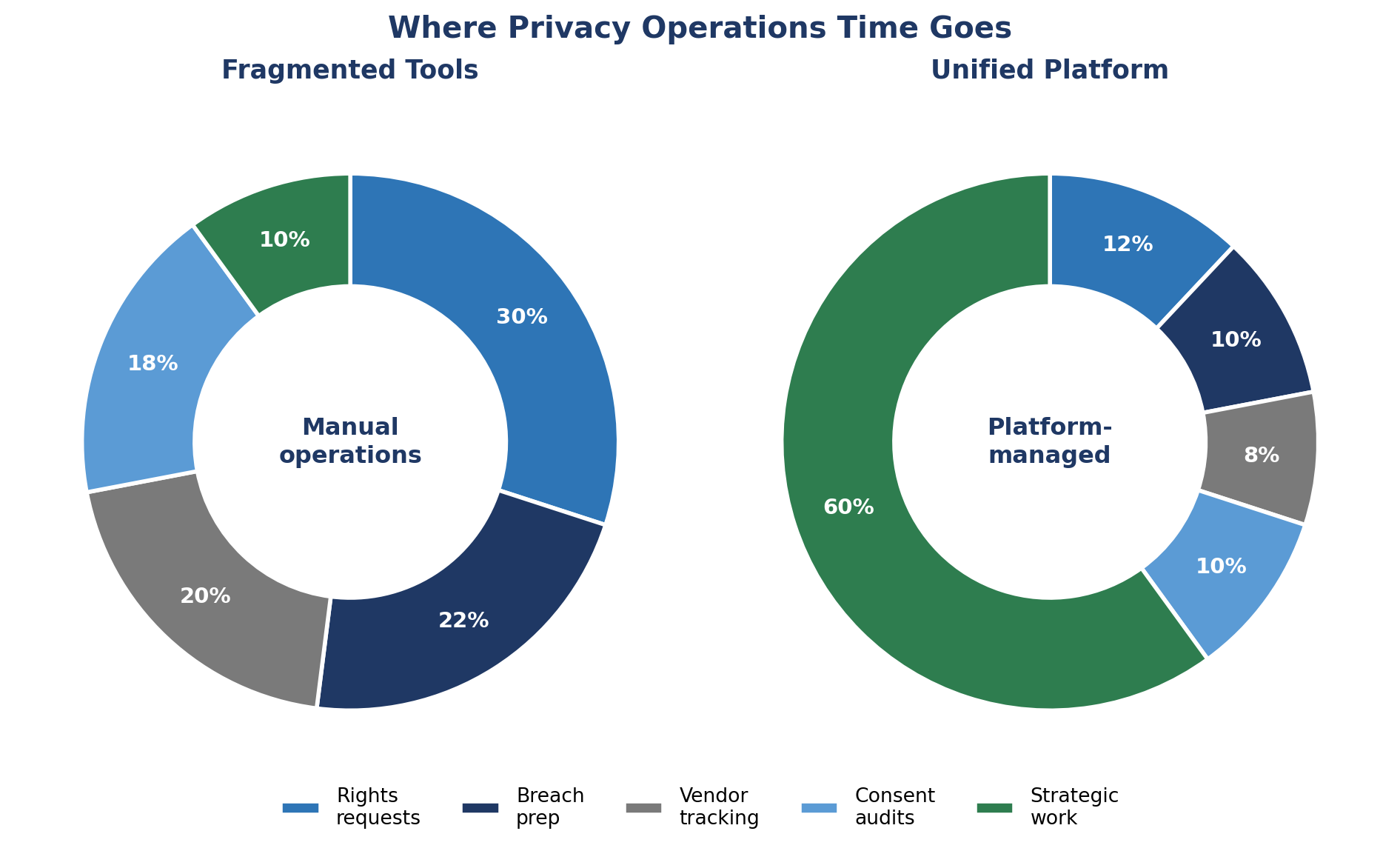
Illustrative time allocation across privacy operations tasks — fragmented tools vs. a unified platform. Not a specific client dataset.
The stakeholder nobody manages well: marketing
Every privacy conversation eventually runs into the same quiet resistance, and it rarely comes from legal. It comes from whoever owns growth and ad performance, because their fear is specific and reasonable: stricter consent management means fewer accepted cookies, which means worse ad targeting, which means numbers that look bad in the next campaign review.
This objection deserves an actual answer, not a dismissal. A privacy management platform built with this in mind gives marketing something legal-and-compliant tools rarely bother with: consent analytics broken down by variant, by domain, by traffic source — so a team can actually test banner copy and placement to improve acceptance rates within the bounds of what's legally required, instead of assuming compliance and performance are permanently at odds.
They're not, usually. A confusing banner tanks acceptance rates as much as a strict one does. Getting this right is a design problem as much as a legal one, and it's exactly the kind of thing that gets solved once, centrally, instead of five different teams each guessing independently.
Fragmented tools vs. a unified privacy management platform
| Function | Fragmented Approach | Unified Privacy Management Platform |
|---|---|---|
| Consent tracking | Separate banner tool, disconnected from records | One system, one consent database |
| Rights requests | Scattered inboxes, manual triage | Single queue, SLA timers, auto-escalation |
| Vendor / DPA tracking | Spreadsheet, updated inconsistently | Live register with expiry alerts |
| Breach response | Reports drafted from scratch, one clock (if any) | Both regulatory clocks tracked, reports pre-drafted |
| Cross-team visibility | Each team sees only their own piece | Shared dashboard, role-based views |
| Audit readiness | Reconstructed manually before each review | Continuously current, exportable on demand |
Illustrative comparison reflecting typical fragmented operations versus a consolidated platform approach.
What to actually check before consolidating onto one platform
A few honest questions worth asking any vendor pitching a unified privacy management platform:
Does it genuinely connect rights requests, consent records, and vendor tracking — or is it a cookie banner with a rebranded dashboard sitting on top? Plenty of tools market themselves as platforms while still only handling the front-end consent piece.
Can each team — legal, marketing, IT — see the specific slice relevant to their work without needing full administrative access to everything? Cross-functional only works if it doesn't require everyone to learn everyone else's job.
Does it give marketing something concrete — consent analytics, banner testing — instead of just a compliance mandate to comply with? A platform that only speaks to legal's concerns will get quiet resistance from every other team it touches.
And does it actually integrate with what you already run — your CMS, your e-commerce platform, your existing databases — or does adopting it mean ripping out and replacing tools that already work fine?
Give legal, IT and marketing one shared dashboard
See consent, rights workflows, vendor tracking and breach reporting live — free, no credit card.
Start Free on Consiva.ai — No Credit Card →If this cross-functional sprawl sounds familiar, it's worth looking at how Consiva's platform approaches it — consent, rights workflows, vendor and DPA tracking, and dual-clock breach reporting from one dashboard, with a free tier for teams just getting the basics in place. Two smaller but genuinely useful pieces of that picture are worth reading directly: whether your tags are actually firing before consent — a ten-minute check most teams have never actually run — and the distinction between retention obligations and erasure requests, which trips up more rights-request workflows than almost anything else.
Streamlining privacy operations isn't really about buying fewer tools. It's about making sure the three or four teams who each own a slice of compliance are looking at the same picture, instead of three different ones that happen to disagree the day it actually matters.
Frequently Asked Questions
A cookie consent tool typically handles front-end banner display. A privacy management platform connects that consent data with rights request workflows, vendor tracking, breach reporting, and audit documentation — the operational layer behind the banner, not just the banner itself.
Usually legal or the DPO, IT or security, and marketing, at minimum. Legal owns policy and grievance handling, IT owns the data and vendor relationships, and marketing owns the tag stack the consent banner is meant to govern — all three need visibility, even if only one team administers the platform.
It shouldn't, if the platform includes consent analytics and banner testing. The goal is compliant consent capture with acceptance rates optimised through testing, not a blanket restriction applied without any visibility into what's actually converting.
No. Smaller organisations often run into the same fragmentation — just with fewer people covering more ground, which makes a dropped rights request or an expired vendor agreement even easier to miss. A platform with a free or lower tier can consolidate this before the volume grows.
Start Free — No Credit Card
One domain, 1,000 cookie consents a month, unmetered rights requests, no expiry.