A data privacy platform exists to close that gap — not by adding more policy documents, but by giving the actual mechanics of privacy compliance somewhere to live, get tracked, and get proven.
What "data privacy platform" actually means, beyond the buzzword
Strip away the marketing language and the category is fairly concrete: it's software that handles the operational side of data protection law — consent capture, rights request fulfilment, breach reporting, and knowing where personal data physically sits — instead of leaving each piece to a different spreadsheet, inbox, or half-remembered process.
The distinction that matters: a cookie banner tool handles one slice of this. A genuine data privacy platform handles the whole chain, because the obligations themselves are chained together. Consent without a way to prove what was consented to is worthless in front of a regulator. Rights workflows without knowing where the data physically lives can't actually fulfil an erasure request. Breach reporting without an existing data inventory means someone's guessing, under pressure, exactly when accuracy matters most.
The features that actually earn the word "essential"
Plenty of vendors pad feature lists with things that sound good but don't do much. Here's what actually matters, and why each piece exists.
Consent management that's purpose-specific, not a single checkbox. A blanket "I agree" covering five different uses of someone's data doesn't meet most modern privacy law's bar for informed consent. Purpose-linked consent — separate toggles for analytics, marketing, personalisation — is the baseline, not an advanced feature.
Data principal rights automation. Access, correction, erasure, and grievance requests need to land somewhere trackable, with a countdown timer and an escalation path, not a shared inbox where the eleventh day slips past unnoticed. This is the feature most companies underestimate until the first request actually arrives.
Breach and incident tracking with the right clocks. Different regulatory regimes have different reporting windows, and they don't always run on the same clock. A platform that only tracks one misses exactly the deadline that catches most companies off guard during an actual incident.
Data discovery across your actual systems. Consent and rights workflows are only as good as your ability to locate the data they refer to. A platform that scans your databases — not just your website — is doing something a banner tool structurally cannot.
Audit trail and documentation that generates itself. A Record of Processing Activities that updates from live consent and scan data beats a document somebody edits twice a year, the week before an audit, from memory.
Multi-jurisdiction support, if you operate anywhere near global. A platform that only speaks one regulatory language becomes a liability the moment a customer, a partner, or an expansion plan crosses a border.
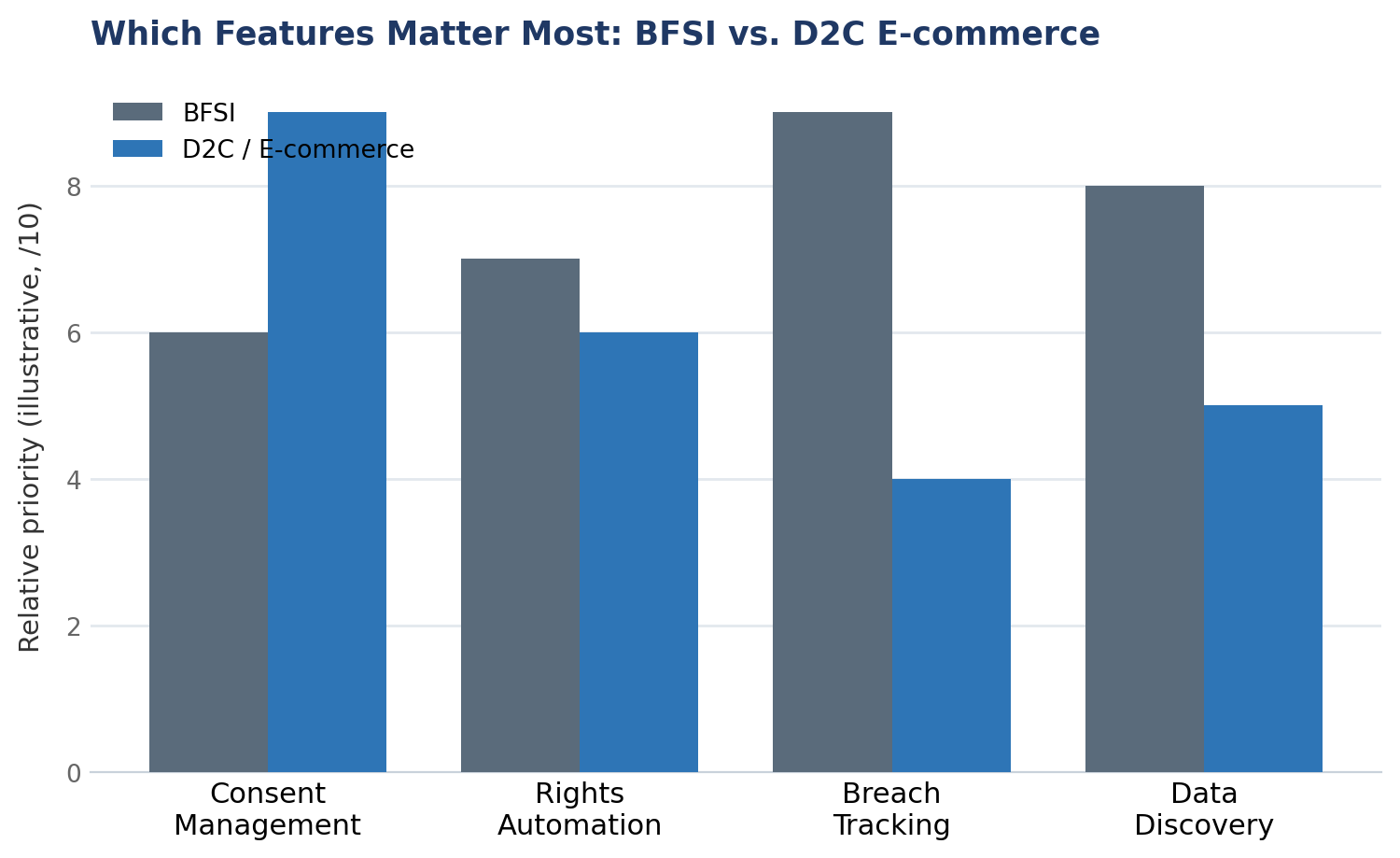
Illustrative feature priority by segment, not a specific client dataset.
The benefits, stated plainly instead of vaguely
It's easy to describe benefits in abstractions — "peace of mind," "reduced risk." Worth being more specific than that.
Reduced regulatory exposure is the obvious one, but it's not just about avoiding a fine. It's about having something to show a regulator or an auditor when they ask a specific, pointed question — not a policy document, but an actual, timestamped record of what happened and when.
Operational time gets back, too. Every hour a compliance or legal team spends manually triaging a rights request, cross-checking a vendor spreadsheet, or drafting a breach report from a blank page is an hour not spent on work that actually grows the business. Automating the repetitive parts of privacy operations isn't glamorous, but it's real hours back on a real calendar.
There's a trust dividend that's easy to underrate. A visible, well-designed consent experience — not a dark-pattern banner designed to frustrate users into accepting everything — signals something to customers who are paying more attention to this than they used to. It's a small thing, cumulatively, but it's not nothing.
And there's deal velocity. Big buyers now send security and privacy forms to vendors before they sign a deal. If you can reply fast and share real documents right away, the process moves sooner. Without that, the talks often pause while legal checks everything in a backlog.
Use cases, because "privacy platform" means something different by industry
This is where generic advice usually breaks down, because what a data privacy platform actually needs to do varies a lot by sector.
D2C and e-commerce. Checkout data, order history, loyalty programmes, and a marketing stack running a dozen trackers simultaneously. The priority here is usually consent management done well enough that acceptance rates don't collapse, plus a plugin-speed integration with whatever storefront platform is already running.
BFSI. Regulatory overlays stack on top of standard privacy law — sector-specific data retention and reporting requirements that shorten timelines further. Breach tracking and audit-grade documentation matter more here than almost anywhere else, because a financial regulator asks different, sharper questions than a general data protection authority does.
Healthcare. Patient data carries its own sensitivity tier, and records move between providers, insurers, and labs constantly. Data discovery matters intensely here — legacy hospital information systems are exactly the kind of sprawling, undocumented data estate where "we don't actually know where everything is" turns out to be the honest answer.
EdTech. Parental and guardian consent for minors is one of the strictest, most specific obligations in most privacy frameworks, and it's also one of the easiest to get quietly wrong, because it requires a verification workflow most generic tools don't build for.
SaaS and IT services. Often wearing two hats at once — a data fiduciary for their own operations and a processor for enterprise clients' data. That dual role means vendor and sub-processor tracking matters as much as their own consent management does.
Startups. Usually operating under lighter-touch exemptions initially, but growing into full obligations faster than expected. The mistake here isn't ignoring privacy — it's assuming there's more runway before it matters than there actually is.
Data privacy platform use cases, by industry priority
| Industry | Primary Need | Feature That Matters Most |
|---|---|---|
| D2C / E-commerce | Consent without hurting conversion | Consent analytics + plugin integration |
| BFSI | Regulatory-grade audit trail | Breach tracking + documentation |
| Healthcare | Locating sensitive data across legacy systems | Data discovery |
| EdTech | Verifiable parental consent | Age-gated consent workflows |
| SaaS / IT | Dual fiduciary-processor obligations | Vendor and sub-processor tracking |
| Startups | Building compliance before scale outpaces it | Lightweight rights automation |
Illustrative mapping based on typical sector priorities, not a specific client dataset.
What to actually look for, sector aside
A few things worth checking regardless of which use case fits your business.
Do you really get the level of features your field needs, or is it just another setup with the usual basics? A lot of people feel let down when a tool claims it can do something, but it does not fit the duties they actually have.
Can you deploy it without a multi-week engineering project? For most mid-market and smaller businesses, a plugin or script-tag deployment matters more than an impressive feature list nobody has bandwidth to implement.
Does it scale with you — free or entry tier for getting the basics live, with a clear upgrade path once volume or regulatory exposure actually grows? Overpaying for enterprise-grade tooling on day one is its own kind of waste.
See the full operational chain, not just a banner
Try consent, rights automation, breach tracking and data discovery live — free, no credit card.
Start Free on Consiva.ai — No Credit Card →If you want to see how this maps to a specific sector, Consiva's industry pages break down the obligations relevant to SaaS, D2C, BFSI, healthcare, EdTech, and startups individually, rather than treating every business as if it faces identical requirements. And the FAQ page is a reasonably direct way to check specifics — free plan limits, what Data Discovery actually scans, how multi-framework consent routing works — without sitting through a sales call first.
A data privacy platform earns its cost when it actually reflects what your specific business processes, not when it's the same generic banner every competitor is also running.
Frequently Asked Questions
A cookie consent tool typically handles front-end banner display only. A data privacy platform connects that consent layer with rights request automation, breach reporting, data discovery, and audit documentation — the full operational chain, not just its first link.
No. The needs change a lot by sector. D2C often focuses on getting consent right while still driving sign ups. BFSI and healthcare usually care more about audit logs and finding where data sits. EdTech tends to require proof of parental consent. SaaS teams often want vendor tracking as much as they want consent controls.
Most platforms in this category offer free or entry tiers covering basic consent and cookie management, scaling up to fuller automation as request volume or regulatory exposure grows. It's rarely an enterprise-only category anymore.
Basic consent management can be live within minutes of deployment. The operational benefits — fewer manually-handled rights requests, faster breach response, audit-ready documentation — typically become visible within the first one to two compliance cycles, as data accumulates in the system.
Start Free — No Credit Card
One domain, 1,000 cookie consents a month, unmetered rights requests, no expiry.