
The DPDP Act 2023 isn't theoretical anymore. The Board exists. The Rules are notified. And the clock that matters most — 13 November 2026, when the penalty and Consent Manager registration machinery switches on — is roughly two months away as of today. The full-compliance deadline, 13 May 2027, is closer to eight months out. That sounds like runway. It isn't, once you account for how long consent infrastructure, rights workflows, and breach reporting actually take to stand up properly.
Why "we'll handle it manually" stops working almost immediately
A cookie banner is the easy part. Plenty of businesses already have one — often a GDPR-generic one, borrowed from a template, saying "we value your privacy" without saying anything DPDP actually requires.
The harder part starts after someone clicks "accept." Where does that consent record live? Can you prove, six months later, exactly what a specific user agreed to and when? What happens when that same user emails asking you to delete their data — does that request land in a shared inbox, get triaged by whoever's free, and quietly slip past whatever timeline the law expects?
And then there's the part almost nobody has actually built: a breach doesn't trigger one clock. It triggers two. CERT-In's Directions require incident reporting within 6 hours. The DPDP Board's own notification window runs separately, at 72 hours. Most companies have exactly zero automated way of tracking either deadline, let alone both, simultaneously, under pressure, during an actual incident.
This is precisely the gap a DPDP compliance tool exists to close. Not to replace legal judgment — a tool doesn't tell you whether a specific processing activity is lawful, that's still a job for counsel — but to make sure the operational machinery around consent, rights, and breach reporting doesn't depend on a spreadsheet and someone's memory.
What automation actually replaces (and what it doesn't)
A real DPDP compliance tool isn't one feature bolted onto a cookie banner. It's a stack of separate but connected obligations, each with its own deadline and its own failure mode:
- Consent capture — purpose-linked, not a single blanket checkbox, with an immutable, timestamped record of exactly what was agreed to and under which notice version.
- Data principal rights workflows — access, correction, erasure, and grievance requests routed automatically, with an SLA timer counting down and escalation before anything breaches deadline, instead of living in an inbox.
- Dual-clock breach tracking — CERT-In's 6-hour window and the DPDP Board's separate notification window, tracked independently, with the notification report auto-drafted so nobody's writing that document from scratch at 2 a.m.
- Data discovery — scanning your actual databases (SQL Server, PostgreSQL, MySQL) to find where personal data physically sits, because you can't honour an erasure request over data you can't locate.
- Audit trail and ROPA — a Record of Processing Activities that updates itself from real scan and consent data, instead of a Word document someone updates twice a year, right before an audit.
None of this replaces a Data Protection Officer, a privacy consultant, or legal counsel. What it replaces is the manual, error-prone version of the same work — the version where compliance depends entirely on someone remembering to check a spreadsheet.
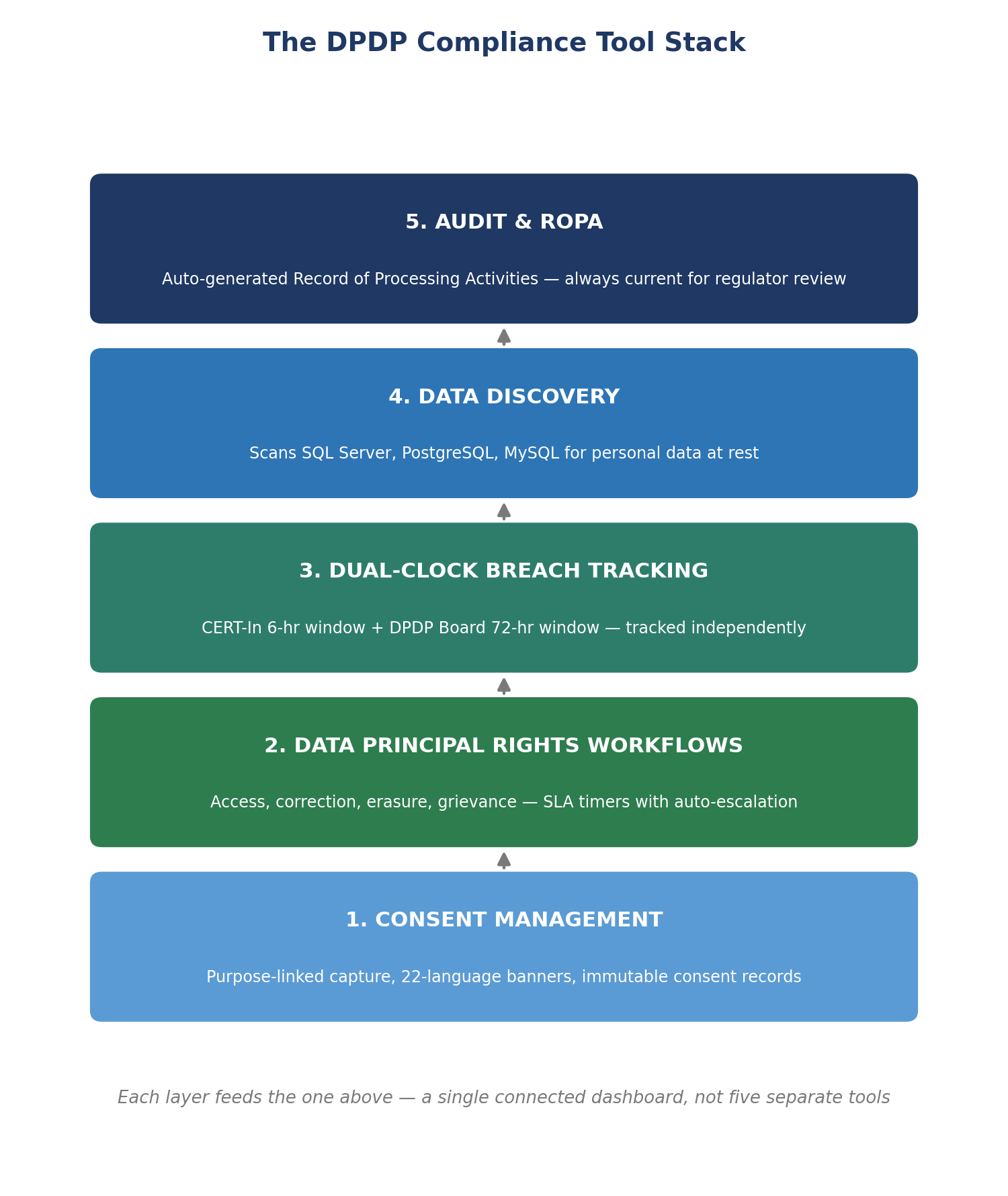
How the layers of a DPDP compliance tool connect — consent, rights, breach reporting, discovery, and audit, feeding one dashboard instead of five separate systems.
Manual compliance vs. an automated DPDP compliance tool
| Task | Manual / Spreadsheet Approach | Automated DPDP Compliance Tool |
|---|---|---|
| Consent record | Blanket checkbox, no version history | Purpose-linked, timestamped, immutable |
| Rights request tracking | Shared inbox, manual follow-up | SLA timer with auto-escalation |
| Breach reporting | One clock tracked (if any), reports drafted from scratch | CERT-In 6-hr + DPDP 72-hr tracked independently, auto-drafted |
| Data discovery | "We think we know where the data is" | Automated database scan, PII pattern detection |
| ROPA | Updated occasionally, before an audit | Generated continuously from live scan and consent data |
| Language coverage | English only, usually | Notices in any of the 22 Eighth Schedule languages |
Illustrative comparison reflecting how most Indian organisations currently handle these obligations versus what a purpose-built platform automates.
Why "built for DPDP" is not the same as "GDPR with an India label"
This distinction matters more than it sounds like it should. GDPR and DPDP share a family resemblance — both regulate personal data — but the specifics differ enough that a retrofitted tool tends to miss exactly the parts unique to Indian law.
DPDP requires notices in English or any of the 22 Eighth Schedule languages, not just English. It runs two separate breach clocks — CERT-In's 6-hour window sits alongside the Board's own notification timeline, and a GDPR-first tool built around a single 72-hour clock simply doesn't have a slot for the other one. Grievance redressal has its own resolution timeline the fiduciary has to demonstrably meet, not just acknowledge. And under Rule 8, there's a 48-hour advance notice requirement before erasure completes — something a European framework has no reason to have built in at all.
A DPDP compliance tool built natively for this law handles these as first-class features, not as an edge case somebody adds later. That's the actual test worth applying to any vendor: ask them directly whether their breach tracker was designed around DPDP's specific dual-clock structure, or whether it's a GDPR module with a rebadged notification form.
What to actually check before choosing one
A few practical, unglamorous questions that matter more than the sales pitch:
Does it track the CERT-In 6-hour window and the DPDP Board's window as two genuinely separate, independently-timed processes — or does it collapse them into one generic "breach notification" feature? This is the single clearest signal of whether a tool was built for DPDP specifically.
Can it actually scan your databases, or does it stop at the cookie banner? Front-end consent without back-end data discovery means you can record that someone withdrew consent, and still have no way to act on it, because nobody can find where their data actually lives.
Does it store consent logs, rights requests, and breach reports on infrastructure that meets India's data residency expectations under DPDP — or does the audit trail itself sit somewhere the law wasn't really written for?
And practically: can you get a working consent banner live today, without waiting on an engineering sprint? A WordPress plugin or a Shopify one-click install matters more than it sounds like it should, for any business without spare developer bandwidth this quarter.
See what a purpose-built DPDP tool actually automates
Run a free scan on your own site — no credit card, no engineering sprint required.
Start Free on Consiva.ai — No Credit Card →If you're weighing this decision now, it's worth starting with something concrete rather than a sales call — what DPDP compliance software actually costs in India is a reasonable place to see how the market's actually priced before anyone pitches you anything. Consiva's own free plan covers basic cookie scanning and DPDP banners in English and Hindi at no cost, with the fuller automated workflows — CERT-In tracking, 22-language notices, automated rights handling — available once volume or risk actually calls for it. And if a question about penalty exposure or a specific obligation comes up along the way, the penalties and enforcement breakdown covers what's actually in Schedule 1, rather than a vendor's rounded-off version of it.
Compliance, at the end of the day, isn't the policy document. It's whether the operational machinery behind it actually works when a real rights request or a real breach shows up — and whether it was still working the week nobody was paying close attention.
Frequently Asked Questions
Consent capture and version-tracked records, data principal rights request routing with SLA timers, dual-clock breach reporting for CERT-In and the DPDP Board, database-level personal data discovery, and continuously updated ROPA documentation — replacing manual, spreadsheet-based tracking of each.
Not fully. DPDP has specific requirements a GDPR-first tool often misses — 22-language notice support, an independent CERT-In 6-hour breach clock alongside the Board's own window, and a 48-hour advance notice requirement before erasure completes, among others.
Basic cookie consent can be live within minutes via a script tag or a WordPress/Shopify plugin. Fuller automation — rights workflows, breach tracking, database-level data discovery — typically takes longer to configure properly, depending on how many systems and data sources are involved.
For low-volume sites, a free plan covering basic cookie scanning and consent banners can be enough initially. Businesses with meaningful rights-request volume, regulated-sector obligations, or CERT-In exposure generally need the fuller automated workflows a paid tier provides.
Start Free — No Credit Card
One domain, 1,000 cookie consents a month, unmetered rights requests, no expiry.