
Why the Feature List Matters More Than the Sales Pitch
Every vendor in this space sounds compliant. The deck says "DPDP-ready," the demo runs smoothly, the logo wall is impressive. None of that tells you whether the product handles the specific, sometimes awkward obligations the DPDP Act 2023 actually imposes on an Indian business.
And the gap is real. A lot of what gets sold as a DPDP compliance solution in India is a European consent tool with the word "DPDP" swapped in. It'll show a cookie banner and store a consent flag. What it won't do is track the CERT-In six-hour breach clock, keep your data inside India, serve a notice in Tamil, or handle the parental-consent rules for children's data. Those aren't edge cases — they're core to the Indian law, and they're exactly where a retrofitted tool quietly falls short.
So the useful question isn't "are you DPDP-compliant?" — everyone says yes. The useful question is "show me these ten features." What follows is that list, and why each one earns its place.
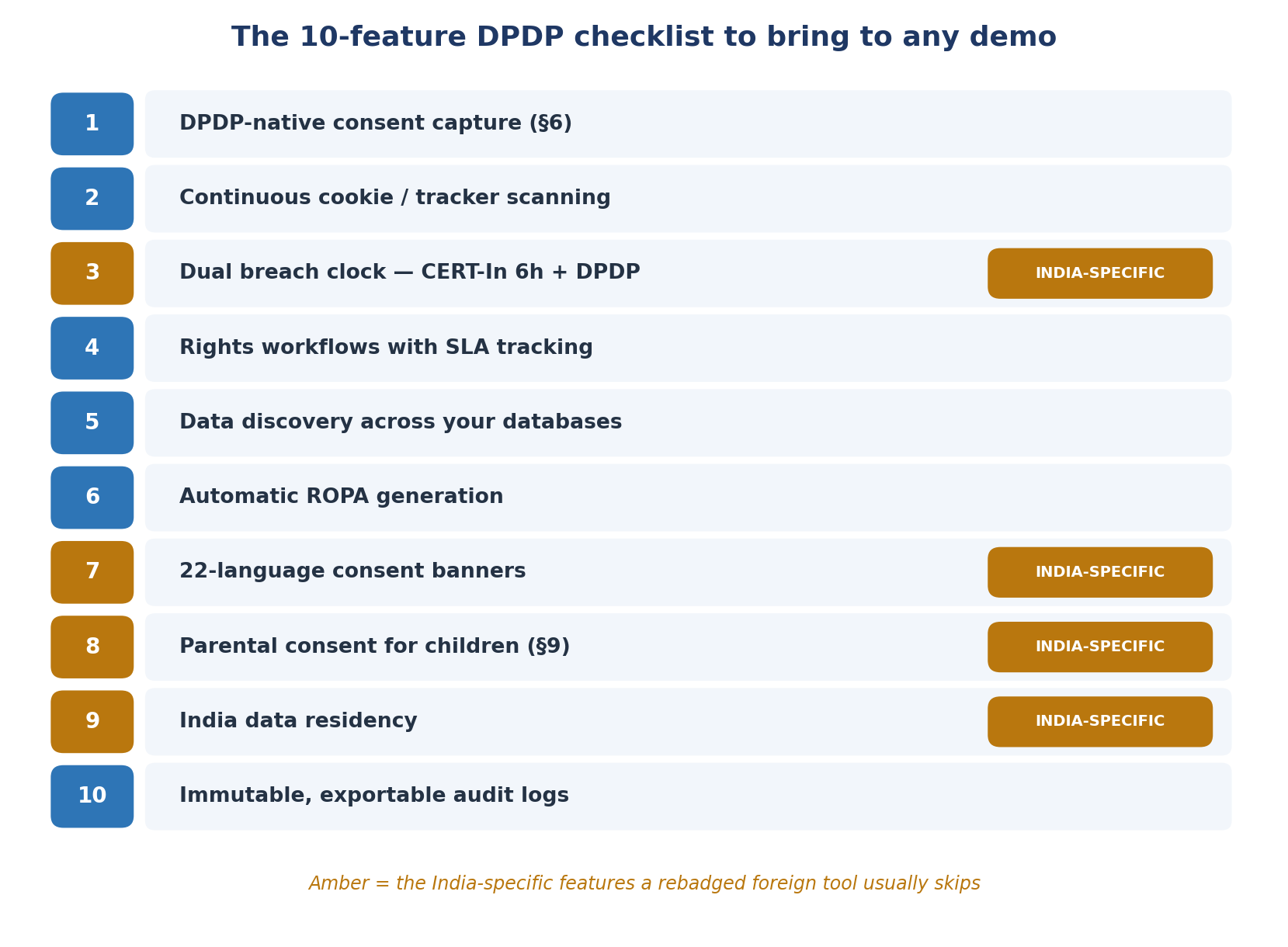
The ten features to demand in a demo — the amber ones are where imported tools quietly fall short.
The Non-Negotiable Features
1. DPDP-Native Consent Capture, Not a Retrofitted Banner
Consent is the foundation the whole law rests on, so start here. Under the DPDP Act 2023, Section 6, consent must be free, specific, informed, unconditional, and unambiguous — and, crucially, you must be able to produce the record later.
A real solution captures consent in that format: purpose-by-purpose, with an immutable timestamp, the notice version shown, and the language it was shown in. A banner that just drops a single "accept" cookie isn't consent — it's decoration. Look for granular, purpose-specific capture and a consent log you could hand a regulator without editing anything.
2. Automatic Cookie and Tracker Scanning
You can't ask for consent to something you haven't found. Marketing plugins, tag managers, and third-party scripts add trackers to your site constantly, often without anyone in the compliance team knowing.
The feature to insist on is a scanner that runs continuously, discovers every cookie and pixel on your domain, and categorises each by purpose — necessary, analytics, marketing, and so on. Without it, your consent banner is disclosing a stale list from whenever someone last checked manually, which is its own gap.
3. The Dual Breach Clock — CERT-In and DPDP, Tracked Separately
This is the single feature that most reliably separates a genuine Indian DPDP compliance solution from an imported one.
A data breach in India starts two independent regulatory clocks at the same time. CERT-In's Directions of April 2022 require reporting a cybersecurity incident within six hours of detection. Separately, the DPDP framework requires notifying the Data Protection Board. Different recipients, different deadlines, different information. Most consent tools track the DPDP side and miss CERT-In entirely — and six hours is not a window you want to discover you've missed.
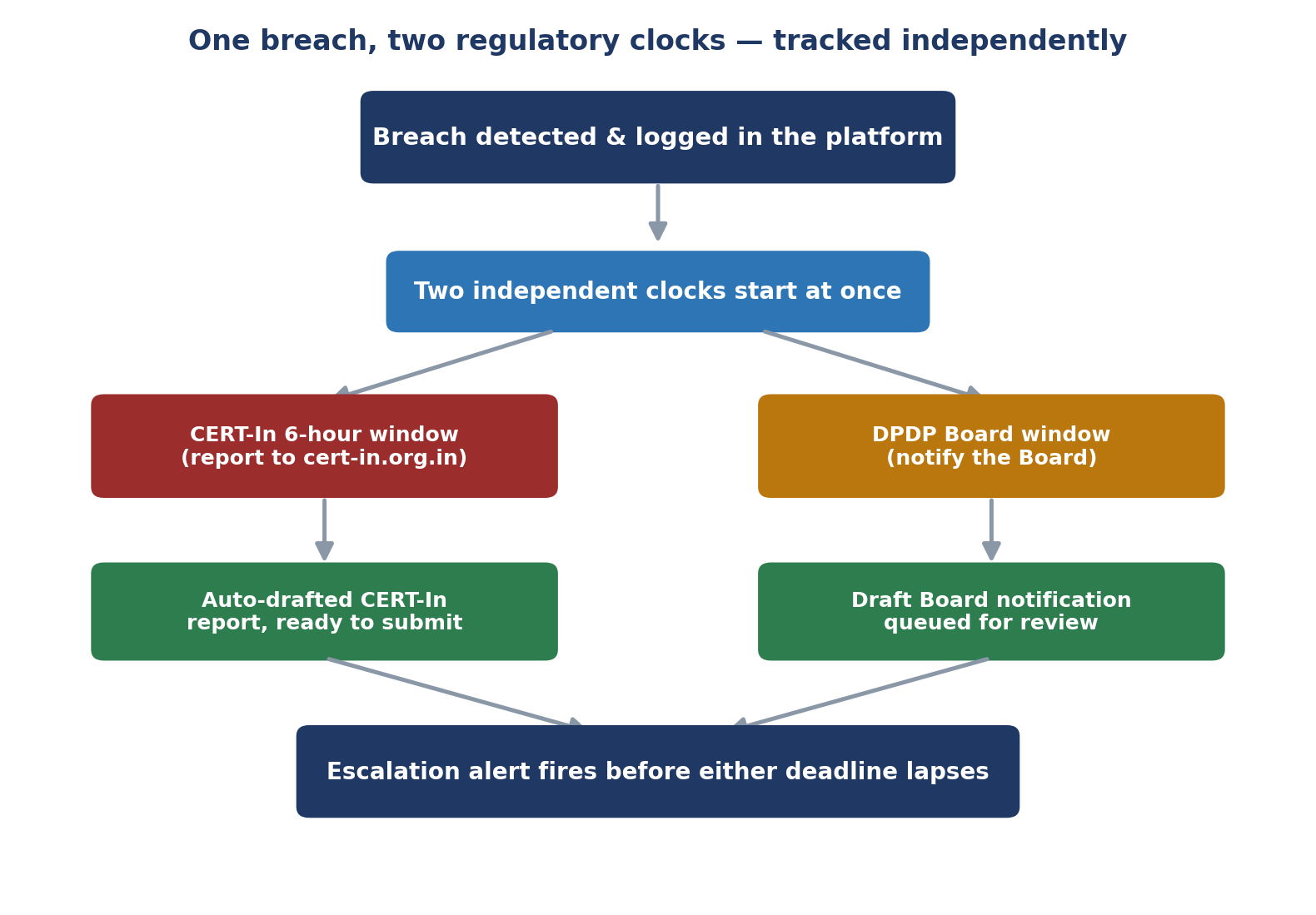
A real approach keeps both timers running from the moment an incident is logged, pre-drafts each report, and escalates before either deadline lapses.
4. Data Principal Rights Workflows With SLA Tracking
The Act lists rights for users in India. They can withdraw consent under §6(4). They can request access under §11. They can ask for correction or deletion under §12. They can file a grievance under §13. They can also appoint another person to act on their behalf under §14. Each request has a due time — if it is missed, that is a breach on its own.
Email can cause delays and uneven handling, and clocks get missed. The workflow should be built for this work: take the request in a single intake flow, confirm who the user is with identity checks before any data is touched, then route the case to the right owner. It should track an SLA timer and warn early so the case does not breach. Each case should also leave an audit record that can be exported.
If a vendor says, "We just log it as a ticket" when asked about erasure requests, do not stop there.
5. Data Discovery Across Your Databases
Here's an uncomfortable truth: you probably don't know where all your personal data is. It's in the main customer table, sure — but also in an old orders database, a support log, an analytics store, a CSV export from a campaign that ended last year.
A strong platform connects to your SQL Server, MySQL, or PostgreSQL databases, scans every table for personal data at rest — emails, phone numbers, Aadhaar patterns — and maps it to your processing purposes. This is what makes an erasure request genuinely complete, and it's the raw material an honest ROPA is built from.
6. Automatic ROPA Generation
The Records of Processing Activities is the document a regulator asks for first and the one that's almost always out of date, because keeping it current by hand means interviewing every team every quarter.
Look for a solution that builds the ROPA automatically — from your consent logs, scan results, and data-discovery findings — and refreshes it on every scan cycle. A ROPA that maintains itself reflects what your systems actually do, instead of what someone remembered to write down months ago.
7. Multi-Language Consent Banners
India is not an English-first market, and the DPDP Act is built around informed consent. A person who can't read the notice hasn't been informed.
The feature here is simple to state and easy to skip: consent banners in the languages your users actually speak, ideally across all 22 Eighth Schedule languages of the Constitution. Hindi, Tamil, Bengali, Marathi and the rest aren't a localisation nicety under this law — they're part of what makes the consent valid.
8. Children's Data and Parental Consent (Section 9)
If anyone under 18 might use your service, this one is mandatory, not optional. DPDP Act 2023, Section 9 requires verifiable parental consent before processing a child's data, and it prohibits behavioural tracking and targeted advertising directed at children.
This solution adds age-gate checks, sets up a step-by-step parent or guardian verification flow, and keeps a full audit log for each under-18 account. Apps in education, games, and consumer software should not go without this. If the feature is missing, it is a dealbreaker.
9. India Data Residency
This is the control question, and for an Indian enterprise it's the most important one on the list. Where does the solution store your consent logs, rights records, breach reports, and audit trails?
If the answer is a foreign cloud, you've handed your compliance evidence to another jurisdiction — awkward under a law with data-localisation expectations. The feature to require is in-region Indian storage for all of it, on every plan, not as a premium add-on. A solution built in India for Indian law treats this as the default, not the upsell.
10. Immutable Audit Logs and Regulator-Ready Export
The thread running through every feature above is proof. The DPDP Act doesn't only ask you to act correctly — it expects you to demonstrate it, on demand.
So the last feature is the one that ties the rest together: every consent event, rights action, and breach record written to an append-only, tamper-evident log you can export for a regulator at any moment. Without it, you can do everything right and still be unable to prove it — which, in an audit, amounts to the same thing as doing it wrong.
Score your own vendor shortlist
Try the consent capture, scanning, and audit-log export live on a free Consiva account — no credit card.
Start Free on Consiva.ai — No Credit Card →A Quick Way to Score Any Vendor
You don't need a procurement spreadsheet to run this test. Bring the ten features to the demo and watch which ones the vendor can actually show you — live, in the product — versus which ones get a "that's on the roadmap."
| Feature Group | What to Demand | How to Read a 'No' |
|---|---|---|
| Consent & scanning | §6 records + continuous tracker scan | Weak, but often fixable |
| Rights & audit | SLA-tracked DSR workflow + exportable logs | Serious gap — you can't prove compliance |
| CERT-In dual clock | 6-hour + DPDP window, tracked separately | Rebadged foreign tool — red flag |
| India data residency | In-region storage on every plan | Rebadged foreign tool — red flag |
| 22-language banners | Eighth Schedule languages, live | Rebadged foreign tool — red flag |
| Section 9 children's data | Parental consent + age-gate + audit | Rebadged foreign tool — red flag |
Treat any solution missing the India-specific items — the CERT-In clock, data residency, multi-language, Section 9 — as a rebadged foreign tool rather than a true DPDP compliance solution.
The Feature Nobody Lists, But Everybody Needs: It All Connects
Here's the thing the feature-by-feature view can miss. Ten separate tools that each do one job well is still ten tools to run, reconcile, and pay for — and the gaps between them are where compliance quietly fails. A deletion request that clears your CRM but not your analytics store. A new tracker the scanner caught but nobody added to the banner. A breach logged in one place and reported from another.
The real gain is when these features live in one connected platform, sharing data. Data discovery feeds the ROPA. Consent logs feed the audit trail. A rights request checks against what discovery actually found. When it's integrated, compliance stops being a set of disconnected chores and becomes a single system you can glance at and trust.
This is where a purpose-built Indian platform shows its design. Consiva was built natively around DPDP 2023 — the dual CERT-In and DPDP breach clocks, 22-language banners, India data residency on every plan, Section 9 parental-consent workflows, data discovery, and self-updating ROPA — in one dashboard, rather than assembled from parts. The point isn't any single feature. It's that they were designed to work together, for the Indian law, from the start.
The Bottom Line
Picking a DPDP compliance tool is about what it does, not what it is called. Lots of vendors say they are ready. Few can show the details in real time — like a system that matches CERT-In timelines, a Tamil interface that actually renders correctly, a consent step that involves parents, and an export option for audit logs when a regulator asks.
Bring the ten-point list to your next demo. The vendor who can demonstrate all of them — especially the India-specific ones a foreign tool skips — is the one worth signing. The rest are asking you to take "DPDP-compliant" on faith, and faith isn't a feature.
Frequently Asked Questions
The non-negotiables are DPDP Section 6 consent capture with immutable records, continuous cookie scanning, the dual CERT-In (6-hour) and DPDP breach clocks tracked separately, data-principal rights workflows with SLA tracking, data discovery across your databases, auto-generated ROPA, multi-language banners, Section 9 parental consent, India data residency, and immutable audit logs. A tool missing the India-specific ones is usually a foreign platform rebadged for DPDP.
Ask to see the India-specific features live in the demo: the CERT-In six-hour breach clock, consent banners in Indian languages, the Section 9 children's-data workflow, and confirmation that data is stored in India. GDPR tools handle consent and rights well but typically can't do these — because they were built for a different law and retrofitted afterwards.
No. Start with what's most immediately required and most visible — compliant consent capture and a rights-request workflow — then add breach tracking, data discovery, and ROPA as you scale. The advantage of a single connected platform is that each feature plugs into the last, so you're growing into one system rather than bolting on new tools.
Because your consent logs, rights records, and breach reports are your compliance evidence, and the DPDP framework carries data-localisation expectations. If that evidence sits on a foreign cloud, you've introduced a compliance risk of its own. In-region Indian storage — ideally on every plan, not as a paid add-on — removes it cleanly.
Sources & References
- Digital Personal Data Protection Act 2023 — §6 (consent), §§6(4), 11–14 (data principal rights), §9 (children's data & verifiable parental consent).
- CERT-In Directions, April 2022 (under IT Act 2000, §70B) — 6-hour cybersecurity incident reporting requirement.
- Constitution of India, Eighth Schedule — the 22 official languages referenced for consent notices.
This article is general information, not legal advice. Verify current obligations and commencement dates against the latest gazette notifications.
Start Free — No Credit Card
One domain, 1,000 cookie consents a month, unmetered rights requests, no expiry.