
Start With Your Obligations, Not the Feature List
Most buyers begin by comparing feature grids. That's backwards. The right first move is to understand what the DPDP Act 2023 actually requires of your organisation — because that determines which features you genuinely need versus which are just nice logos on a comparison page.
Two businesses can both be "DPDP-regulated" and need very different things. A D2C brand collecting checkout data has one profile. An EdTech company processing children's data triggers Section 9's parental-consent rules, which is a whole additional obligation set. A BFSI firm carries RBI retention rules layered on top of DPDP. A SaaS company sending data offshore has cross-border questions a purely domestic retailer never faces.
So before you shortlist anything, answer three questions about yourself. What personal data do you actually process, and where does it live? Do you touch any special categories — children's data, health data, financial data — that carry stricter rules? And what's your breach exposure, given that a single incident starts both the CERT-In and DPDP clocks? Your answers turn a generic feature list into a specific requirement list. That list is what you shop with.
The Non-Negotiables: What Any Serious Platform Must Have
Some things aren't preferences — they're the price of entry. If a platform can't do these, it's out, regardless of how polished the rest looks.
It has to be built for Indian law, not adapted to it. This is the biggest fork in the road. A great many platforms sold in India are GDPR tools with "DPDP" added to the marketing. They handle consent and rights competently, then miss the things that are specific to India: the CERT-In six-hour breach clock, consent notices in Indian languages, the Section 9 children's-data rules, and data residency. A platform designed around DPDP 2023 from the start treats these as core; a retrofitted one treats them as gaps.
It has to keep your data in India. Your consent logs, rights records, and breach reports are your compliance evidence. If they sit on a foreign cloud, you've introduced a data-localisation problem of your own making. In-region Indian storage should be standard on every plan, not a premium tier.
It has to produce evidence, not just perform actions. The DPDP Act expects you to prove compliance on demand. Every platform can show a banner; far fewer produce an immutable, timestamped, regulator-exportable audit trail of every consent event and rights action. Without that, you can do everything right and still fail an audit.
It has to track both breach clocks. A breach in India triggers CERT-In's six-hour reporting window and the DPDP Board's notification window simultaneously — different recipients, different deadlines. A platform that tracks only one leaves you exposed on the other.
The Evaluation Framework: Six Lenses to Judge Any Platform
Once a platform clears the non-negotiables, judge the shortlist through six practical lenses. These are what separate a tool you'll be happy with in year three from one you'll be quietly resenting.
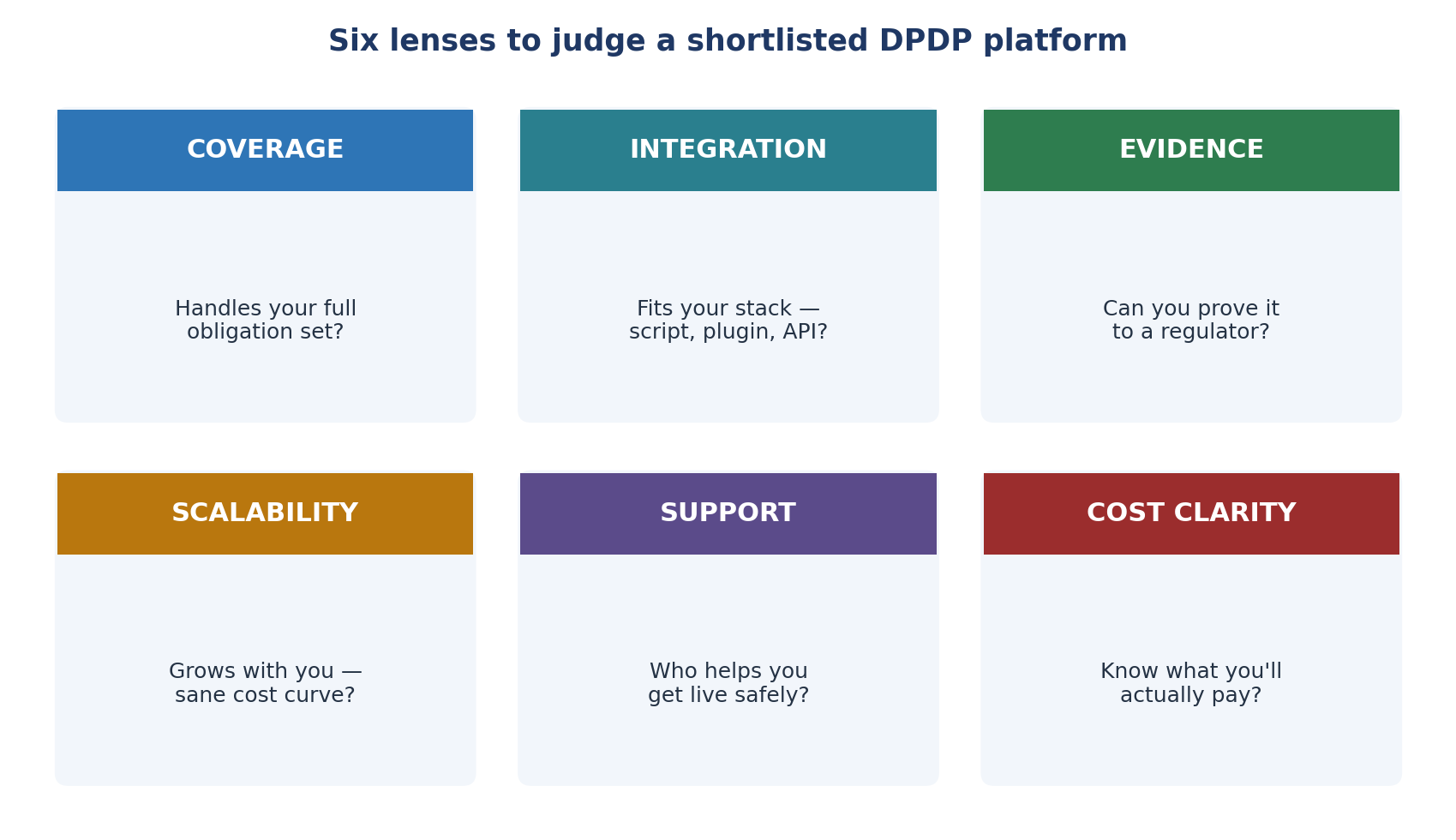
Run every shortlisted platform through these six lenses before you commit.
1. Coverage — Does It Handle Your Full Obligation Set?
Map the platform's features against the requirement list you built earlier. Consent and cookie scanning are table stakes. But does it handle data-principal rights with real SLA tracking? Data discovery across your actual databases? Automatic ROPA? Section 9 parental consent, if you need it? A platform that covers 70% of your obligations means you're back to spreadsheets for the other 30% — which is where compliance quietly fails.
2. Integration — Does It Fit How You Actually Work?
A platform you can't deploy easily is a platform you won't deploy well. Check how the consent banner goes live — a single script tag, a WordPress plugin, a Shopify app? Can it connect to your databases for discovery without a fortnight of engineering? Can it push events to your own systems via webhooks or an API? The easier it slots into your existing stack, the faster you're actually protected rather than mid-migration.
3. Evidence — Can You Prove It to a Regulator?
Buyers often miss this part. But regulators will ask for proof, and you should be able to show it fast — not weeks later, and not with a last-minute scramble.
Start with records that do not change. Use audit logs that stay intact. Keep a case trail you can export — this matters for rights requests too. Store consent entries with clear versions, so the timeline is easy to check. Also watch for the "show me the evidence" moment: if the only way to answer is for someone to write a new database query, then you likely have a gap — and that gap will show up during an audit.
4. Scalability — Will It Grow With You?
The platform that fits your five-person startup should still fit you at fifty domains and millions of consents. Check how pricing scales — per domain, per consent, per seat — and whether the cost curve stays sane as you grow. A cheap headline plan that balloons at volume, or a platform that can't add domains without a rebuild, becomes an expensive migration later.
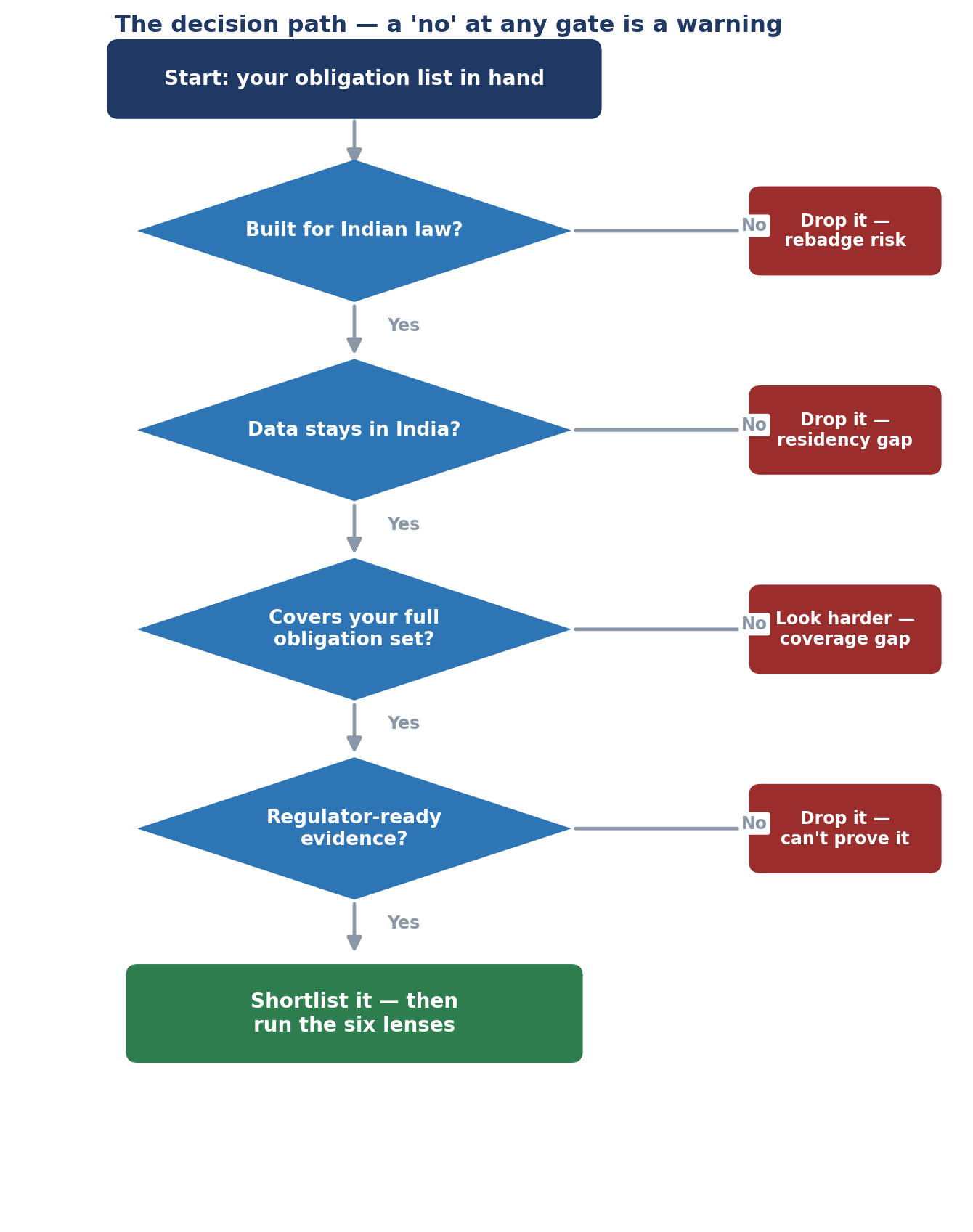
The decision path: filter by the non-negotiables first — a 'no' at any gate is a reason to look harder.
5. Help and Setup
A compliance tool only pays off after it is working in your world. Before you buy, ask about the onboarding steps you get and how fast support answers real issues, and who you can reach if something goes wrong at the worst time. A strong platform is still a problem if setup is weak — what the vendor does to get you live tells you what to expect later.
6. Cost Transparency — Do You Know What You'll Actually Pay?
Many DPDP vendors won't publish a price, which is itself a signal. You want a clear split between what's fixed and what scales, no surprise per-use charges, and ideally a free tier to prove the fit before committing. A platform that lets you start small — a free plan covering basic consent, say — and scale deliberately is one you can budget around.
Test the fit on your own site first
Deploy the consent banner, run a scan, and check the records it produces — one domain, free, no credit card.
Start Free on Consiva.ai — No Credit Card →The Traps That Catch Buyers
A few mistakes show up again and again in DPDP platform selection. Knowing them in advance is cheap; learning them mid-contract isn't.
| The Trap | Why It Costs You | The Fix |
|---|---|---|
| Choosing on the demo, not the obligations | The slickest demo is the best-rehearsed pitch, not the best fit | Score against your requirement list, not the presentation |
| Assuming a global brand means Indian coverage | A known GDPR tool can still miss CERT-In, Indian languages, and §9 | Brand ≠ fitness for Indian law — verify the India-specific features |
| Underweighting evidence | You discover the proof gap only during an audit | Demand immutable, exportable audit logs up front |
| Not thinking about where the data sits | Data residency is a compliance issue, not a footnote | Ask early; get the answer in writing |
| Choosing the lowest price and fixing it later | A cheap tool that can't scale or prove compliance means a rebuild | The option you replace in a year isn't the cheapest |
Why "Built for India" Is the Deciding Factor
If you take one principle from all of this, make it this one: a DPDP compliance platform designed natively for Indian law will almost always beat a foreign platform adapted to it, on the things that actually matter to an Indian organisation.
That's not brand loyalty — it's architecture. A platform built around DPDP 2023 from the first line handles the dual CERT-In and DPDP breach clocks, serves consent banners across the 22 Eighth Schedule languages, runs Section 9 parental-consent workflows, keeps data in India, and connects all of it into one evidence trail. A retrofitted tool can bolt some of that on, but the seams show, and the seams are where audits find gaps. This is where Consiva sits in the market: built natively for DPDP 2023 — dual-clock breach tracking, 22-language banners, India data residency on every plan, Section 9 workflows, data discovery, and self-updating ROPA in a single dashboard — with a free tier so you can prove the fit before committing a rupee.
Making the Decision
Here's the sequence, condensed. Map your obligations first. Filter the market by the non-negotiables — Indian-native, data in India, real evidence, both breach clocks — which will cut a long list to a short one fast. Then run the short list through the six lenses: coverage, integration, evidence, scalability, support, and cost. Where a free tier exists, use it to test the fit on your own site before you sign anything.
The reassuring part is that the up-front effort is small against the downside it protects you from — up to ₹250 crore per category of violation under DPDP Act 2023, Section 33, plus CERT-In exposure on top. A few days spent choosing well is cheap insurance against years spent regretting a rushed pick.
The Bottom Line
The right DPDP compliance platform isn't the one with the biggest logo or the smoothest demo. It's the one that matches your actual obligations, keeps your data and evidence in India, tracks both regulatory clocks, and lets you prove all of it to a regulator on demand. Start from what the law requires of you, filter hard on the things that can't be compromised, and test the fit before you commit. Do that, and the platform you choose becomes something you barely think about — which, for compliance software, is exactly the goal.
Frequently Asked Questions
Start with your own obligations, not the feature grid. Map what personal data you process, whether you touch special categories like children’s or financial data, and your breach exposure. That gives you a specific requirement list. Then filter platforms by the non-negotiables: built natively for Indian law, data stored in India, immutable regulator-ready evidence, and tracking of both the CERT-In and DPDP breach clocks.
A GDPR tool can manage consent and user rights, but it is made around European rules. It often fails to cover key duties in India — for example, it may not follow the CERT-In breach timeline of six hours, may skip consent notices in the 22 languages listed in the Eighth Schedule, can miss the parental consent rules in Section 9, and may not support India data residency in a solid way. A DPDP-native platform treats these items as normal parts of the system rather than an afterthought. That is why being built for India matters more than the name on the marketing page.
Not on price alone. The lowest quote often hides a platform that can't scale, can't produce audit evidence, or stores your data abroad — any of which forces an expensive rebuild later. Look instead for transparent pricing with a clear fixed-versus-variable split, and ideally a free tier so you can prove the fit before committing. The cheapest option you have to replace in a year is rarely the cheapest.
Use a free tier where one exists. Deploy the consent banner on your own site via the script tag or plugin, run a cookie scan, and check the consent records it produces. Ask the vendor to demonstrate the India-specific features live — the CERT-In clock, an Indian-language banner, the Section 9 flow — rather than describe them. What a platform can show you in the product is worth more than anything in the deck.
Sources & References
- Digital Personal Data Protection Act 2023 — §9 (children's data & verifiable parental consent), §33 & Schedule (penalties, up to ₹250 crore per category of violation).
- CERT-In Directions, April 2022 (under IT Act 2000, §70B) — 6-hour cybersecurity incident reporting requirement.
- Constitution of India, Eighth Schedule — the 22 official languages referenced for consent notices.
This article is general information, not legal advice. Verify current obligations and commencement dates against the latest gazette notifications.
Start Free — No Credit Card
One domain, 1,000 cookie consents a month, unmetered rights requests, no expiry.