
The Problem Isn't the Law. It's Keeping Up With It.
Ask a compliance lead what keeps them up at night and it's rarely the text of the DPDP Act itself. The obligations are knowable. What's hard is doing all of them, at once, all the time, across a business that keeps changing underneath you.
Think about what "being compliant" actually asks of you on any given Tuesday. Every visitor to your site needs a valid consent record before a single analytics tag fires. Every data-principal request — access, correction, erasure, grievance — has a clock on it. Every cookie a marketing plugin quietly added last week needs to be found, categorised, and disclosed. Every database holding customer emails needs to show up in your ROPA. And if a breach hits, two separate regulatory clocks start at once — CERT-In's six-hour window and the DPDP Board's — and neither cares that it's a weekend.
No team does all of that reliably by hand. Not because they're not capable, but because it's not a human-scale problem. It's a monitoring-and-record-keeping problem, running continuously, and that's exactly the kind of work software is built for.
So What Is DPDP Compliance Software, Really?
Strip away the marketing and it's one thing: a system that turns scattered, manual privacy tasks into a single connected workflow you can actually keep on top of.
Instead of a consent banner in one place, a spreadsheet of deletion requests in another, and a vague hope that someone remembers the CERT-In deadline, DPDP compliance software pulls the whole obligation set into one dashboard. Consent capture, rights-request handling, breach tracking, data discovery, ROPA — all connected, all logged, all producing the evidence a regulator would ask for.
That last part matters more than it sounds. The DPDP Act doesn't just ask you to do the right things. It expects you to be able to prove you did them, on demand, with timestamps. A good platform is really an evidence machine wearing a compliance interface.
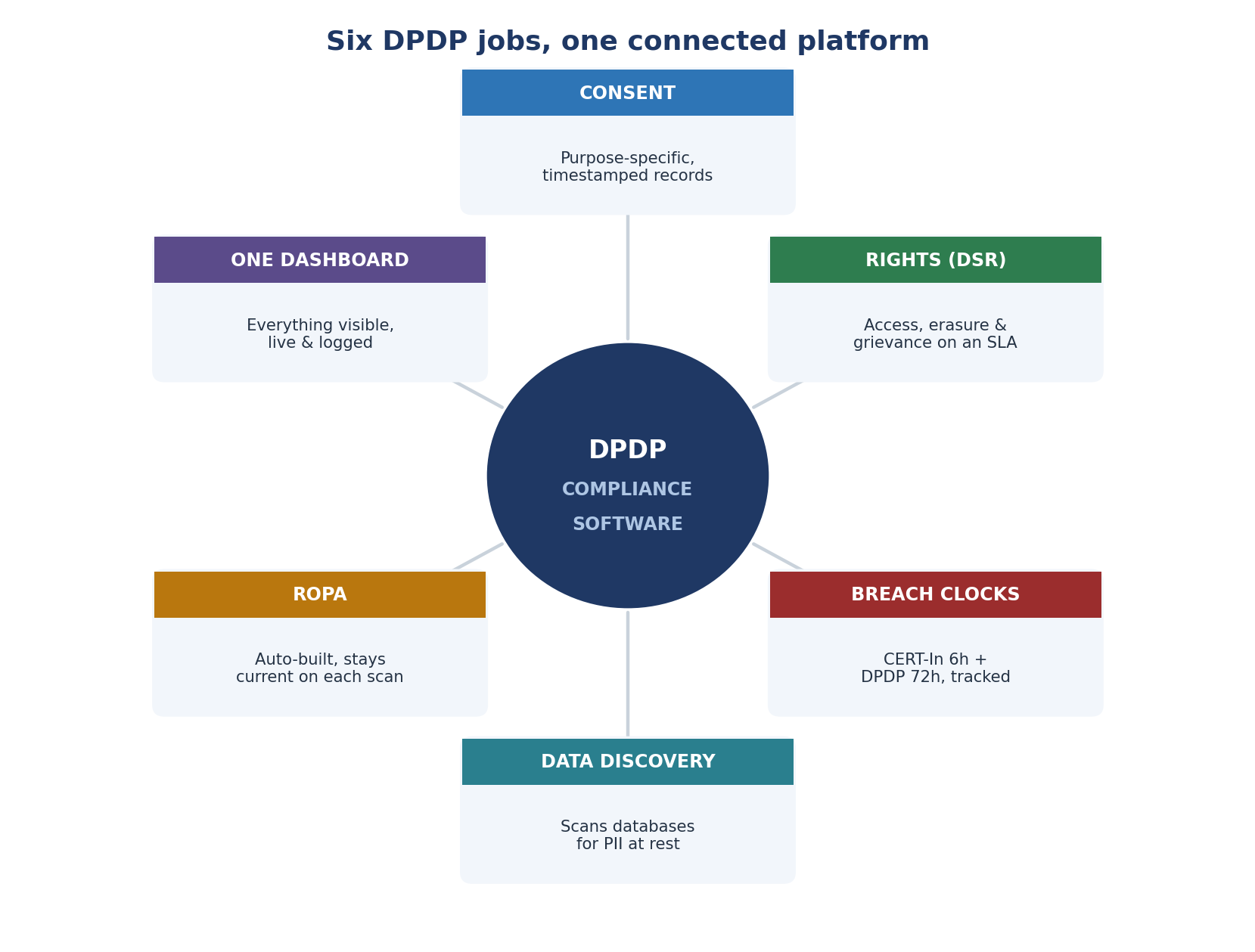
DPDP compliance software connects six obligations — consent, rights, breach, discovery, ROPA — in one dashboard.
Where the Software Actually Earns Its Place
Six jobs, specifically, are where the manual approach breaks and software takes over cleanly.
Consent That Holds Up as Evidence
A cookie banner isn't consent. Consent is a record: who agreed, to what purpose, when, in what language, and the ability to produce that record later. The software captures consent in the DPDP Act 2023, Section 6 format — purpose-specific, timestamped, immutable — and stores it in a log you can hand to a regulator without flinching. It also scans your own domain continuously and catches the trackers that CMS plugins and tag managers add without telling anyone, so nothing fires before the visitor has actually agreed.
And because India isn't an English-only market, the banner needs to speak the visitor's language. Serving consent notices across the 22 Eighth Schedule languages of the Constitution isn't a nice-to-have; under a law built around informed consent, a Hindi or Tamil speaker being shown an English-only notice is a genuine gap.
Data Principal Rights, on a Timer
Every Indian user has rights under the Act — to withdraw consent (§6(4)), access their data (§11), correct or erase it (§12), raise a grievance (§13), or nominate someone to act for them (§14). Each request carries an SLA, and missing it is its own violation.
Handled by hand, requests get lost in a support inbox and answered inconsistently. Handled by software, every request gets logged the moment it arrives, identity-verified before any data moves, routed to the right owner, and tracked against a countdown that escalates before the deadline — not after you've already breached it. The whole case leaves an audit trail you can export as a PDF.
The Breach Clock That Nobody Tracks Manually
Here's the one most tools miss entirely. A data breach in India starts two independent clocks: CERT-In's six-hour reporting window (CERT-In Directions, April 2022), and the DPDP Board's notification window. They have different recipients, different deadlines, different required information. Most consent tools track one and quietly ignore the other.
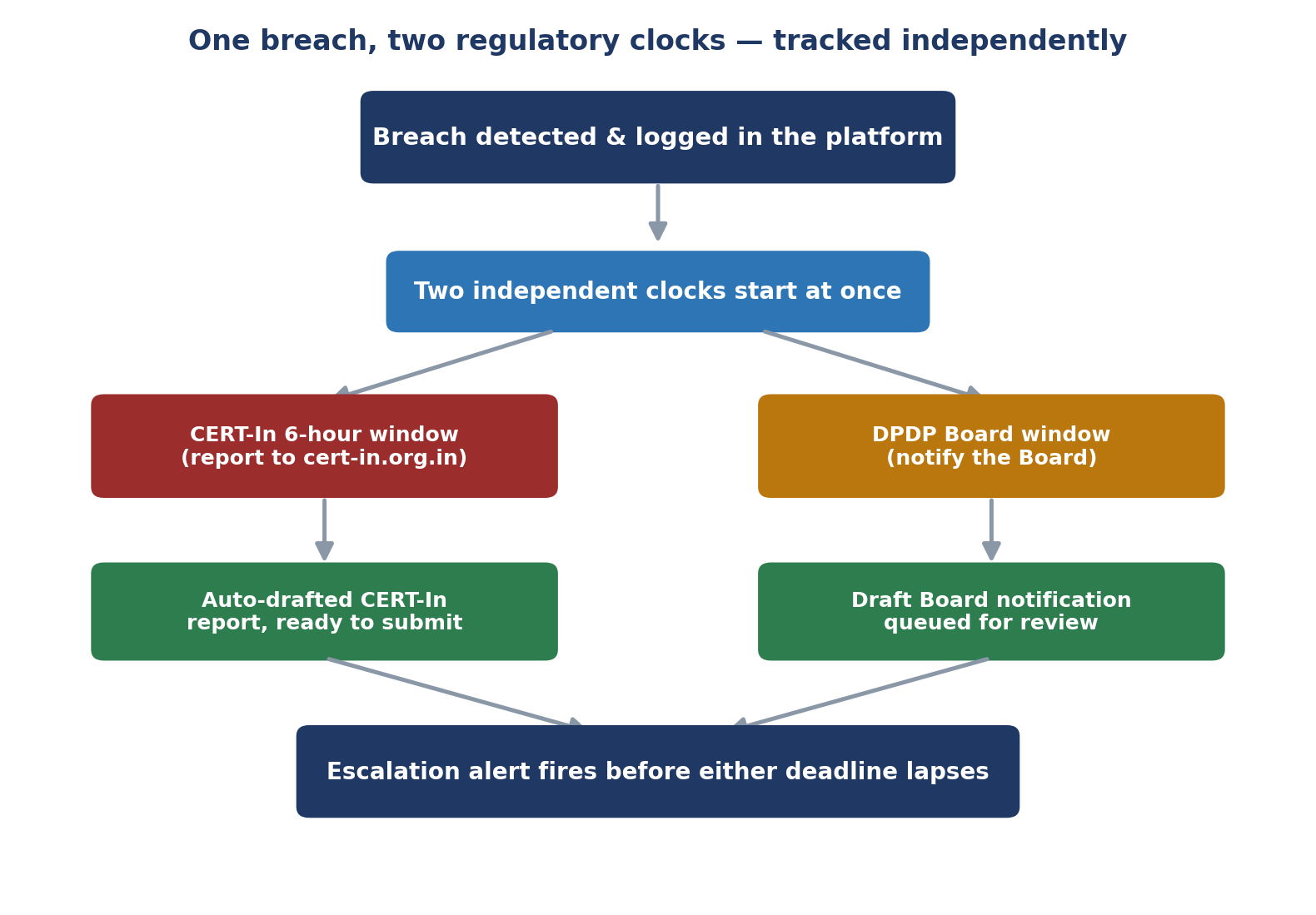
A single breach triggers both clocks at once — compliant software runs them independently and pre-drafts each report.
Software built for the Indian reality runs both timers side by side from the moment an incident is logged, pre-drafts the report each regulator needs, and alerts you before either deadline lapses. Six hours is brutally tight when you're also trying to contain the incident — having the CERT-In report auto-drafted rather than written from scratch under pressure is the difference between meeting the window and missing it.
Finding the Data You Forgot You Had
You can't protect, disclose, or delete data you don't know exists. And most businesses have personal data sitting in databases nobody's thought about in a year — an old orders table, a support log, a CSV export from a cancelled campaign. A good platform connects to your SQL Server, MySQL, or PostgreSQL databases, scans every table for personal data at rest — emails, phone numbers, Aadhaar patterns — and maps what it finds to your processing purposes. That discovery is what makes an erasure request actually complete, and what keeps your ROPA honest.
A ROPA That Stays Current on Its Own
The Record of Processing Activities is the document a regulator asks for first, and the one that's almost always out of date, because maintaining it by hand means chasing every team every quarter. When ROPA is generated automatically from your consent logs, scan results, and data-discovery findings, it updates itself on every scan cycle. It reflects what your systems actually do — not what someone remembered to write down six months ago.
One Dashboard Instead of a Dozen Tabs
The quiet benefit underneath all of this is simply that it's in one place. Consent rates, pending rights requests, open breaches, discovered data, ROPA — visible together, updating live. Compliance stops being a periodic fire drill and becomes something you can glance at and trust.
Run a real scan on your own site — free
Most people are surprised by their own tracker inventory. One domain, 1,000 cookie consents a month, no credit card.
Start Free on Consiva.ai — No Credit Card →The Part Indian Businesses Should Care About Most: Where the Data Lives
There's a control question underneath the convenience one, and for an Indian enterprise it's the more important of the two.
A lot of privacy tooling sold in India routes consent records, rights data, and breach reports through infrastructure hosted abroad. That's awkward under a law with data-localisation expectations, and it quietly hands your compliance evidence to someone else's jurisdiction. The cleaner answer is software that stores all of it — consent logs, rights records, breach reports, audit trails — inside India, on in-region infrastructure. It removes a structural risk rather than papering over it.
This is where a platform built natively for the Indian law, rather than a GDPR tool with a DPDP skin, genuinely differs. Consiva was designed around DPDP 2023 from the first line: the dual CERT-In/DPDP breach clocks, the 22-language banners, India data residency on every plan, and the DPDP Section 9 parental-consent workflows for children's data. It's the difference between software that covers Indian requirements and software that starts from them.
Manual vs. Software: The Honest Comparison
To be fair about it — small, simple sites can limp along manually for a while. The gap opens fast as you scale.
| Obligation | Done Manually | With DPDP Compliance Software |
|---|---|---|
| Consent | A static banner, no real record | Immutable, timestamped, purpose-specific records (§6) |
| Rights requests | Triaged in an inbox, inconsistent | Tracked SLAs with auto-escalation before breach |
| Breach reporting | Depends on someone remembering | Both CERT-In & DPDP clocks run automatically, reports pre-drafted |
| ROPA | A spreadsheet stale within weeks | Regenerates on every scan cycle |
| Data inventory | Whatever people recall | Databases scanned for PII at rest |
| Under audit | A list of gaps | Evidence you export and move on |
The cost of the software is small and predictable. The cost of a gap — up to ₹250 crore per category of violation under DPDP Act 2023, Section 33, plus the CERT-In exposure on top — is neither.
Where to Start
You don't boil the ocean. The sensible sequence is the same one that works for any compliance programme: get consent right first, because it's the most visible and the most immediately required. Then stand up your rights-request workflow and your breach tracker, because those are the most time-sensitive. Then connect your databases for discovery and let ROPA build itself. A platform that does all of this from one place means each step plugs into the last instead of becoming another disconnected tool.
The reassuring truth is that the setup is fast — a consent banner can be live in minutes via a single script tag or a WordPress plugin — while the protection it gives you compounds for years. That asymmetry, small effort now against large risk later, is the whole case for using software instead of willpower.
The Bottom Line
The DPDP Act isn't going to get simpler, and your data footprint isn't going to shrink. What this software does is take a sprawling, continuous, evidence-hungry obligation and make it something a normal team can actually run — reliably, in one place, with the proof already assembled for the day someone asks. That's not a shortcut around compliance. It's just the only realistic way to do it well.
Frequently Asked Questions
It brings every DPDP obligation into one connected system: it captures purpose-specific consent as timestamped, immutable records; manages data-principal rights requests on tracked SLAs; runs the dual CERT-In (6-hour) and DPDP Board breach clocks; discovers personal data across your databases; and auto-generates your ROPA. The core value is that it produces regulator-ready evidence automatically, rather than leaving you to assemble it under pressure.
If you process personal data of Indian users, the Act applies regardless of your size — and manual methods stop being reliable quickly. A small site can start with a free tier that covers cookie consent and basic rights handling, then add automation as it grows. The point isn't company size; it's whether you can produce proof of compliance on demand, which is hard to do by hand at any scale.
The right one does. Look for a platform that stores all consent logs, rights records, breach reports, and audit trails on in-region Indian infrastructure — that's the clean route to meeting DPDP's data-localisation expectations. Tools that route this evidence through foreign clouds create a compliance risk of their own. Consiva keeps all of it in India on every plan.
Yes. A capable platform detects a visitor's jurisdiction and serves the right consent framework — DPDP in India, GDPR in the EU, CCPA in California — from a single script tag, while tracking CERT-In and DPDP breach obligations independently. That's far simpler and safer than stitching together separate tools for each regime.
Sources & References
- Digital Personal Data Protection Act 2023 — §6 (consent), §§6(4), 11–14 (data principal rights), §9 (children's data), §33 & Schedule (penalties, up to ₹250 crore per category).
- CERT-In Directions, April 2022 (under IT Act 2000, §70B) — 6-hour cybersecurity incident reporting requirement.
- Constitution of India, Eighth Schedule — the 22 official languages referenced for consent notices.
This article is general information, not legal advice. Verify current obligations and commencement dates against the latest gazette notifications.
Start Free — No Credit Card
One domain, 1,000 cookie consents a month, unmetered rights requests, no expiry.